

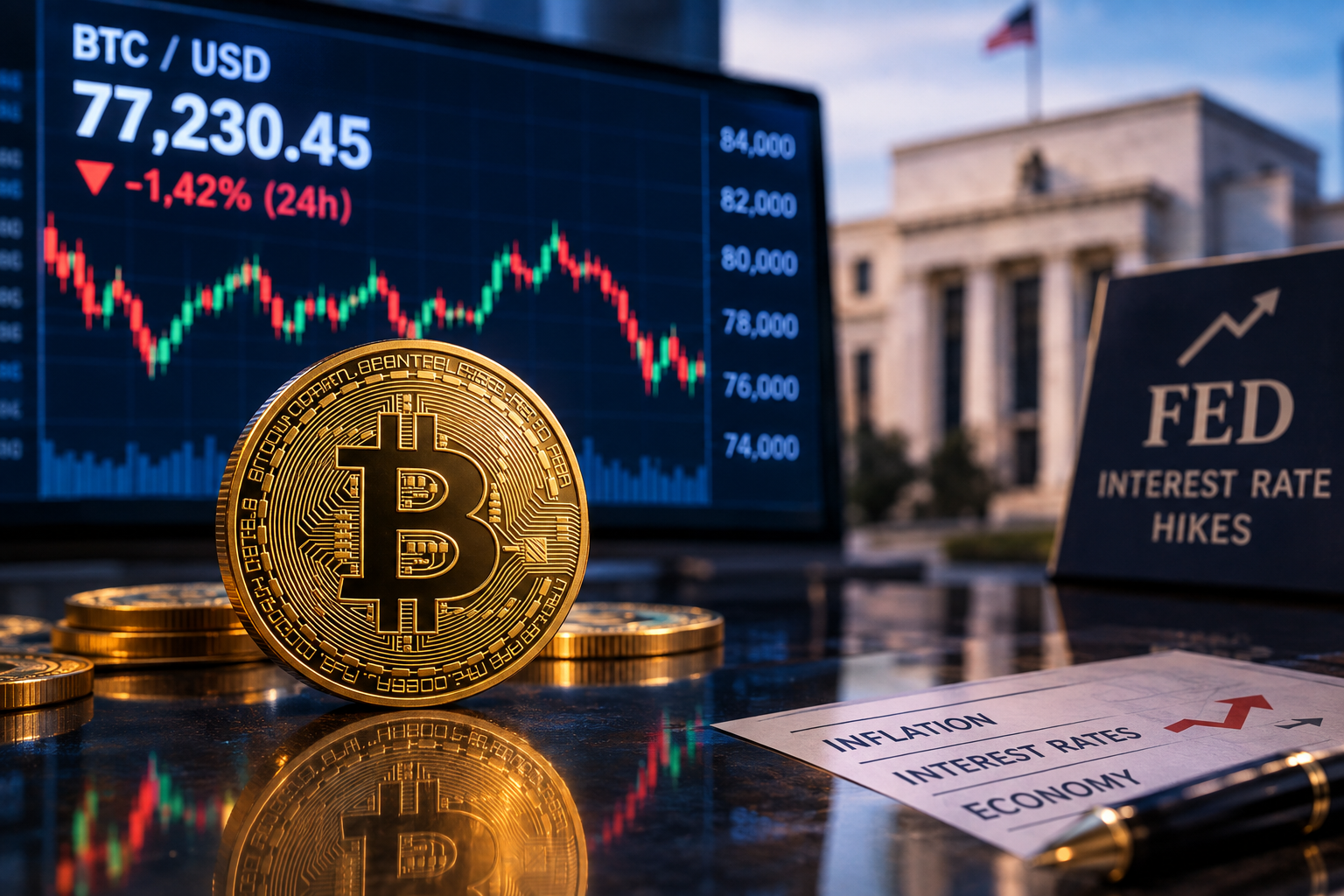
Bitcoin is holding near the $77,000 level as investors assess the growing possibility of a Federal Reserve interest-rate hike. The cryptocurrency remains under pressure after failing to sustain its move above $80,000, while stronger U.S. inflation data has increased uncertainty across financial markets.
Recent market data shows Bitcoin trading around the $77,000–$78,000 range, with traders closely watching the Federal Reserve’s upcoming September meeting. The combination of inflation concerns, higher Treasury yields, and changing interest-rate expectations is keeping cryptocurrency investors cautious.
Bitcoin Struggles Below $80,000
The $80,000 level has become an important psychological barrier for Bitcoin. After recovering strongly and attempting to move above this level, BTC has struggled to maintain enough momentum to establish a sustained breakout. Buyers remain active, but market sentiment has become more cautious.
Bitcoin’s inability to remain above $80,000 suggests that investors are waiting for a stronger catalyst before pushing prices higher. For now, the cryptocurrency is consolidating near $77,000, making the $80,000 resistance level one of the most important areas for traders to monitor.
Fed Rate Hike Expectations Increase
The biggest issue currently facing Bitcoin is the changing outlook for Federal Reserve interest rates. Recent U.S. inflation data has strengthened expectations that the Fed could raise interest rates at its September meeting. Core consumer prices increased 0.3% in August, above economists’ expectations of 0.2%, while annual headline inflation remained at 3.4%.
Markets reacted quickly to the inflation report, with interest-rate futures showing a significantly higher probability of a September rate hike. This development has increased uncertainty across risk assets, including cryptocurrencies.
Why Higher Rates Can Pressure Bitcoin
Higher interest rates can create challenges for Bitcoin because investors may prefer traditional assets such as U.S. Treasury securities when their yields become more attractive. At the same time, tighter monetary policy can reduce liquidity flowing into higher-risk investments.
Bitcoin is often treated as a risk-sensitive asset, meaning it can respond strongly to changes in monetary policy. If investors expect borrowing costs and Treasury yields to remain high, demand for speculative assets could weaken and increase short-term selling pressure on BTC.
Inflation Remains a Key Concern
The Federal Reserve’s main challenge remains inflation. Although inflation has moved down significantly from previous peaks, it is still above the central bank’s long-term 2% target. Recent inflation reports have raised concerns that price pressures may not be cooling as quickly as policymakers would prefer.
Higher energy prices are making the situation even more complicated. Global oil prices have recently moved above $100 per barrel amid geopolitical tensions and supply concerns. Higher energy costs can contribute to broader inflation and potentially make it more difficult for the Federal Reserve to adopt a more accommodative monetary policy.

Can Bitcoin Reclaim $80,000?
The ability to reclaim $80,000 will be an important test for Bitcoin bulls. A sustained move above this psychological level could improve market sentiment and encourage traders to target higher resistance zones. It would also show that buyers remain confident despite concerns about interest rates.
On the other hand, repeated failures around $80,000 could encourage investors to take profits or reduce their exposure. If Bitcoin eventually breaks above the level with strong trading volume, the move could strengthen the short-term bullish outlook and potentially open the door toward higher price targets.
What Happens If BTC Falls Below $77,000?
The $77,000 area is another important level because it represents the lower part of Bitcoin’s current trading range. A decisive break below this area could indicate that sellers are gaining greater control of the market and could increase the possibility of a deeper short-term correction.
However, a decline below $77,000 would not automatically mean that Bitcoin’s long-term bullish trend has ended. Cryptocurrency markets are highly volatile, and temporary corrections are common even during larger upward trends. Investors should therefore consider broader market conditions rather than reacting to a single daily price movement.
The Fed Meeting Could Trigger Volatility
The Federal Reserve’s September meeting is likely to be one of the most important events for Bitcoin investors this month. Markets will focus not only on the interest-rate decision but also on the Fed’s economic projections and comments about future monetary policy.
A rate hike combined with hawkish guidance could create additional pressure on Bitcoin and other risk assets. However, if policymakers indicate that future decisions will depend heavily on incoming economic data, investors could interpret the message as less aggressive and potentially provide some relief to cryptocurrency markets.
Bitcoin Price Outlook
Bitcoin’s short-term outlook remains uncertain as traders balance bullish technical factors against a more challenging macroeconomic environment. Holding above $77,000 could allow BTC to build a stronger base and make another attempt at $80,000.
A successful breakout above $80,000 could restore bullish momentum and attract additional buyers. In contrast, sustained weakness below $77,000 could increase the risk of a deeper correction. For this reason, the $77,000 support and $80,000 resistance zones remain two of the most important levels to watch.
Conclusion
Bitcoin is entering an important period as it trades near $77,000 while expectations for a Federal Reserve rate hike continue to rise. Persistent inflation, higher oil prices, and elevated Treasury yields are creating a challenging environment for risk assets.
At the same time, Bitcoin remains close enough to $80,000 that a renewed wave of buying could quickly change market sentiment. The key question for investors is whether BTC can defend $77,000 and reclaim $80,000, or whether rising interest-rate expectations will trigger another correction.

